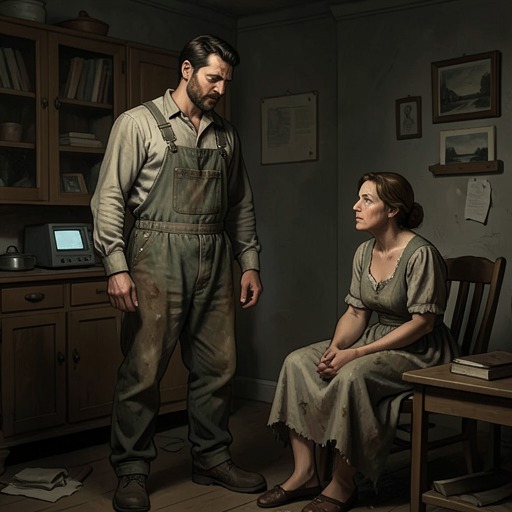
Friendship and collaboration between Redrick Schuhart and Richard Noonan
Roadside PicnicRedrick Schuhart and Richard Noonan’s friendship is marked by an unusual intimacy between a Zone smuggler and a man connected to the institute that once employed Redrick. Noonan can offer his friend a place back at the institute, but Redrick has chosen another kind of work; their conversations therefore balance warmth and practical concern against the distance opened by their opposing occupations. The relationship’s quiet tension is clearest in two encounters: Noonan’s arrival at a bar with a drunken Gutalin, and his later invitation for Redrick to return to the institute.
Friendship in the Bar
During one meeting, Redrick is at the bar, intent on an old-fashioned one-armed bandit. He is putting in his last nickel when Noonan and Gutalin arrive. Gutalin is blotto, rolling his eyes and looking for somewhere to rest his fist; Noonan holds him tenderly by the elbow. The gesture makes their respective conditions visible: Gutalin is in no state to manage himself, while Noonan acts as the steady companion who gets him into the bar. Redrick is present as an observer, and the encounter places the familiarity among these men in an ordinary public setting rather than in a formal conversation about their work.
Noonan’s composure does not mean that he is unconcerned with danger. In a later conversation about the trade in Zone goods, he says that he would hate to be found dead in bed after having committed suicide. He stresses that he is not a stalker, describes himself as practical, and says that he likes living, a habit he has kept for a long time. His dry self-description gives Redrick a glimpse of the caution beneath Noonan’s good humor. Noonan does not claim the risk-taking identity of the stalkers; he values survival and regards that preference as the sensible basis for his choices.
Work, Risk, and Mutual Candor
Redrick explains the meaning of a “full empty” after Noonan asks what the term means, distinguishing it from a plain empty. Noonan listens, nods, and smacks his lips. The small exchange shows Redrick sharing specialized knowledge from the Zone trade with a friend whose own work does not make him a stalker. Their conversation is direct and unceremonious: Noonan can ask about an unfamiliar item, and Redrick can explain it without turning the exchange into a performance of authority.
The wider discussion is not merely technical. Redrick considers who might want witches jelly and for what, and says that neither he nor Buzzard Burbridge would make a deal of that kind. Noonan agrees with Redrick’s reservations, then explains his own reluctance through his fear of a supposed suicide in bed. This moment connects their candor to the moral and physical hazards of the black market: Noonan can understand why Redrick would hesitate, but the danger also confirms why Noonan prefers a life outside stalking. Their friendship makes room for shared judgment without erasing the difference between their exposure to risk.
That conversation is interrupted by Ernest, who calls from the bar that Noonan has a telephone call. Noonan reacts angrily, suspecting that it must be Shipping Adjustment again. The interruption pulls him back toward his business obligations, a reminder that his time in the bar is not separate from the work that organizes his life. The familiar irritation also gives Redrick access to Noonan’s everyday frustrations, rather than presenting him only as an institutional representative.
The Offer to Return
Later, Redrick sees Noonan leave a hotel at twenty to nine. Noonan is chewing something and arranging his soft hat as he goes down the steps. He appears short, plump, pink, freshly washed, and confident; the narration also describes him as lucky and well-off. The detail sets him apart from Redrick, whose circumstances and choices have taken him away from the institute. Noonan’s neat, assured departure gives their subsequent conversation a visible contrast in fortunes and ways of life.
Redrick has followed him to the hotel and gives a weak explanation for being there: he says that he had time and thought he might have a cup of coffee. Noonan looks at his watch and says he will not keep Redrick long. He then invites him to drop his unimportant tasks and come back to the institute, adding that they will take him back whenever he wants. The offer is concrete and open-ended: Redrick’s former position remains available, and Noonan presents return as a choice rather than a closed door. His use of Redrick’s familiar name reinforces the personal character of the appeal.
Redrick does not accept. When Noonan asks whether he wants to lend him money, Redrick answers that he has work of his own. Noonan reacts with an exclamation of disbelief and asks who else, then, will take it on. The exchange ends not with a reconciliation of their professional differences but with their difference made plain: Noonan sees the institute as a place Redrick can return to, while Redrick insists that he has another occupation. Their friendship persists in direct address and frank conversation, but it cannot make the two kinds of work interchangeable.
Significance of the Relationship
The relationship joins personal loyalty to an unresolved practical divide. Noonan is attentive to Gutalin, willing to speak plainly about his fear of death, and ready to offer Redrick a route back to secure institutional employment. Redrick, in turn, explains the Zone’s terminology and answers Noonan’s proposal without disguising his decision. Neither man is reduced to his job: Noonan’s care and humor coexist with his caution, while Redrick’s refusal does not prevent him from remaining in conversation with an old colleague and friend.
Their encounters also measure the cost of Redrick’s departure from the institute. Noonan’s offer demonstrates that returning is possible, while Redrick’s reply reveals that the obstacle is not simply a lack of opportunity: he has work, and he does not mean the institute’s. The friendship therefore registers a choice between forms of life without turning that choice into a simple moral opposition. Noonan’s preference for safety and Redrick’s continued involvement in Zone work remain distinct, but their familiarity allows each to speak to the other across that divide.